Buyer guide
Wholesale Makeup Sets: MOQ, Lead Times and Landed Cost Basics
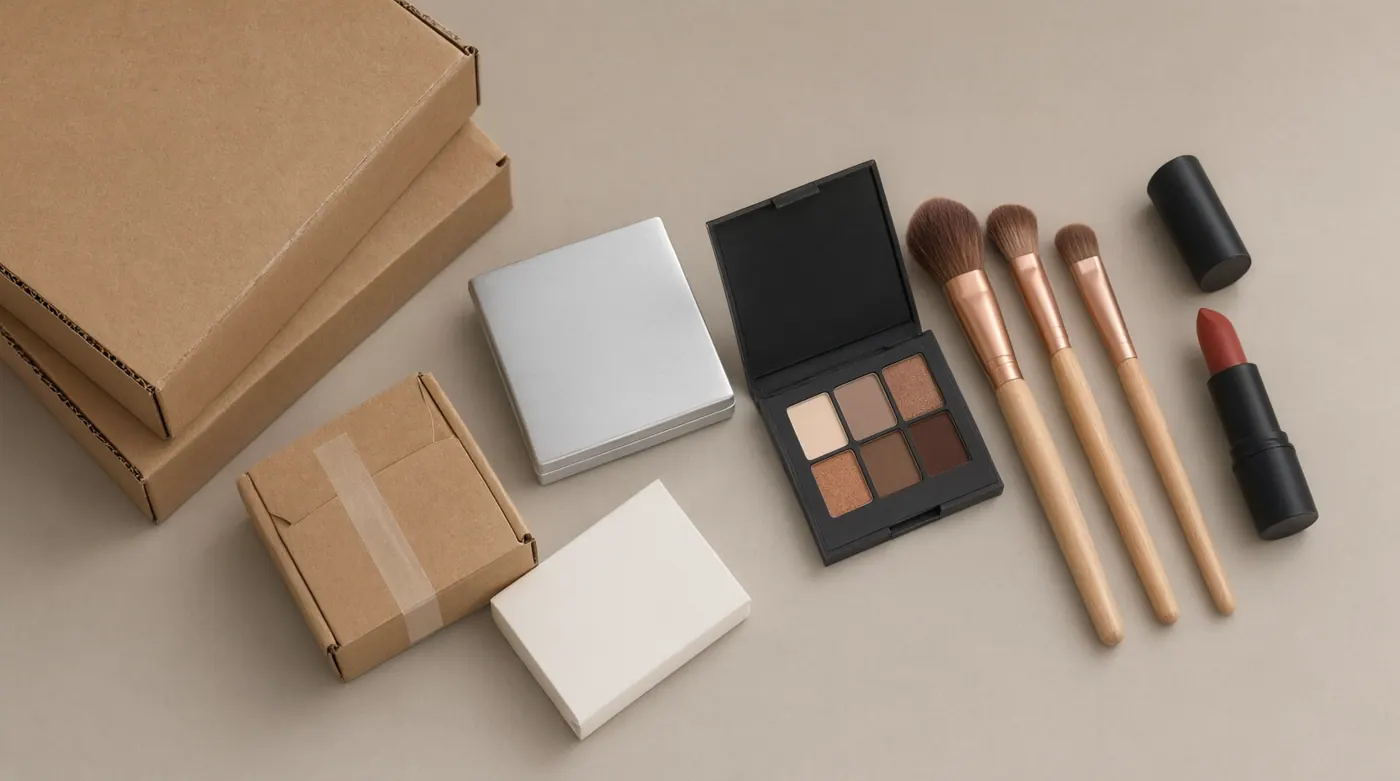
Wholesale makeup sets live or die on three numbers: the minimum order quantity, the day the cartons leave the factory, and the landed cost of one set sitting in your warehouse. Everything else — palette layout, sleeve finish, shade names — is negotiable. Those three are not.
What follows is the conversation we have most weeks with brand owners and retail buyers comparing set suppliers. No pitch. Just the mechanics, so you can put three quotes side by side and see which one is genuinely cheaper.
Set MOQs: the numbers behind "low MOQ"
A set MOQ is never one figure. It follows the process.
| Set format | Typical MOQ | Why it sits there |
|---|---|---|
| Standard-process sets (cases, sleeves, bags and gift boxes) | 3,000 sets | Standard case, sleeve, bag and gift box processes; no special finishing |
| Special processes on a set | 6,000 sets | Electroplating, 3D printing, silk screen, embossing, new mould |
| Bulk makeup sets, basic models | 6,000 pcs | No special finishing, standard components |
| Custom component shells (single items) | 12,000 pcs | Tooling cost spread over a full run |
Two things trip buyers up here. First, the MOQ applies to the set, not to each shade. Second, mixing shades inside one set is free; splitting a run into four colourways is not always. Ask before you build the planogram.
Capacity matters as much as MOQ. Current output runs at 300,000 cosmetic sets a month. A new facility of about 100,000 m² with 45 lines, due to open in 2027, is planned to bring capacity to about 350,000 sets a month. If your launch needs 80,000 sets in eight weeks, that is a scheduling question, so raise it in the first email, not the fifth.
Price breaks: 12k, 30k, 50k, 100k
Quotes move in steps, not smoothly. The tiers we price against are 12,000, 30,000, 50,000 and 100,000 units. Cross a tier and the unit price drops; sit just under one and you pay for a mould that could have been amortised further.
Four levers set the price: order quantity, process complexity, material grade, and how far your spec drifts from a standard line. Plastic sits below acrylic, acrylic below metal, and recycled or degradable materials carry a small premium. Simple wins. A two-piece case with a printed sleeve will always beat a metal case with a mirror, magnets and a flocked insert — and for a first order, that is usually the right call anyway.
Quotations are valid 30 days. Ask for the validity date in writing. Resin and wax costs move, and a quote from March is not a promise in June.
Lead times: three clocks, not one
Buyers often ask for "your lead time" and get one number back. In reality three clocks run in sequence.
| Stage | Standard | Express |
|---|---|---|
| Formula development | 14 days | 7 days (without compatibility and stability work) |
| Samples | 3–7 days | — |
| Production (order confirmed to ex-works) | 45 days | 30 days, priority scheduling |
Samples are free; you cover the freight. Two revisions are free, further rounds are charged at cost. The express production lane exists, but be honest about the trade-off — on express you get a basic pass report first and the complete report follows later. If your retailer needs the full documentation pack before goods ship, do not buy the express lane. You will just be disappointed.
Add shipping on top of all of that. A 45-day production window plus 35 days at sea is an 80-day promise to your buyer, and that is before port congestion.
Payment terms: what 30/70 actually means
The standard structure is 30% deposit with the contract, 70% before shipment, once production and testing have passed. T/T and L/C are both accepted. Terms do vary by client and by order history, so treat the split as a starting point rather than a law.
Why it matters commercially: your deposit releases raw material and packaging, and the balance releases the goods. That is a clean, predictable cash cycle — and it is why a supplier quoting 0/100 should make you pause. Someone is financing your inventory, and you will pay for it in the unit price.
If you use an L/C, agree the document list and the latest shipment date before the contract is signed. Mismatched paperwork is the single most common reason a container sits at port while your launch date burns.
Shipping modes and Incoterms without the fog
Rough transit times after customs clearance: sea freight to North America, Europe and South America runs 30–45 days; air to North America, Europe and the Middle East 7–15 days; express couriers (DHL, FedEx) 3–7 days worldwide; land transport to Southeast Asia and around the Middle East 10–20 days. You can nominate your own forwarder — plenty of buyers do, because they already have a rate card.
Then Incoterms. These three-letter codes decide who pays what and where risk changes hands, and getting them wrong is expensive. The ICC publishes the official Incoterms rules, and they are worth twenty minutes of your time.
- EXW — you collect from our premises. Cheapest on paper, most work for you: export clearance, trucking, everything.
- FOB — we deliver on board the vessel at the named port. This is the default for most set orders and the easiest to compare between suppliers.
- CIF — we pay cost, insurance and freight to your destination port, but risk passes when goods are loaded. The insurance cover is minimum, so read it.
- DDP — we handle everything including duty and import clearance. Convenient, but confirm who is the importer of record and who carries the VAT. It is rarely the supplier.
Documents that travel with the goods
Every batch ships with a product test report, compliance certificate, packing list, delivery note and instructions, plus a copy of the retained-sample report. Batch samples are retained until six months after the end of the product's shelf life. Raw materials carry a COA on file, and third-party reports from labs such as SGS, Intertek or CTI are available per batch on request. For regulated markets you will also want the compliance file — formulations built for EU (EC) No 1223/2009 and REACH, for US FDA and MoCRA requirements, GSO 1943/2021 for the Gulf, TR TC 009/2011 for Russia, and the ASEAN Cosmetic Regulation for Southeast Asia. The European Commission's cosmetics pages are a decent starting point if you are new to the EU framework.
How to compare quotes fairly
Two quotes are only comparable when the spec sheet, the Incoterm and the Incoterm location match. Otherwise you are comparing a car with a bicycle and wondering why one is cheaper.
| Cost line | Ask this | Where money hides |
|---|---|---|
| Unit price | FOB or EXW? | EXW quietly adds export handling |
| Packaging | Is sleeve printing included? | Plate and print set-up charged separately |
| Components | Brushes, puffs, mirror included? | Accessories quoted as add-ons |
| Tooling | One-off or per order? | Mould cost repeated each run |
| Freight | Which port, which mode? | Door delivery vs port to port |
| Duty and tax | Who is importer of record? | DDP quotes with tax excluded |
Landed cost is not the unit price. It is unit price plus packaging, plus freight per set, plus insurance, plus duty, plus port handling and demurrage risk, plus the financing cost of your deposit. A supplier who is 4% cheaper per set but ships two weeks later can easily cost more in lost shelf dates. This matters more than the unit price, and almost nobody models it before signing.
One practical habit: send every supplier the same one-page brief — set composition, shell type, print method, target quantity, destination port, required delivery week. Quotes that answer the same question are worth reading. Quotes that answer different questions are decoration.
Where Magic Color fits
We are Jinhua Magic Color Cosmetic Co., Ltd., a color cosmetics OEM/ODM manufacturer in Jinhua, Zhejiang, near Ningbo and Shanghai. In the industry since 2008, we have 30+ automated production lines, nearly 400 people and about 30,000 m² today. All filling workshops in our current Jinhua factory are Class 100,000 GMPC cleanrooms. A new facility of about 100,000 m² with 45 lines is due to open in 2027. Certifications include GMPC, ISO 22716, BRCGS, SMETA, BSCI and RSPO. We hold 500+ mature formulas and produce over 600 new development samples a year, with automation above 70%.
If you are weighing set suppliers now, start with our wholesale program, look at the makeup gift sets range, and read the custom packaging page before you fix your shell. Questions about MOQ splits or documents go to the FAQ first — most of them are already answered there.
FAQ
What is the MOQ for wholesale makeup sets?
It depends on the processes. Sets with standard processes — standard cases, sleeves, bags and gift boxes — start at 3,000 sets. Sets with special processes such as electroplating, 3D printing or embossing start at 6,000 sets. Basic bulk makeup sets without special finishing start at 6,000 pcs.
How long does a set order take from deposit to shipment?
Formula development takes 14 days standard, or 7 days express. Samples take 3–7 days. Standard production is 45 days from order confirmation to ex-works, or 30 days on the express lane with priority scheduling. Add sea, air or express transit time on top.
What payment terms do you accept?
Usually 30% deposit when the contract is signed and 70% before shipment, after production and testing have passed. T/T and L/C are both accepted, and terms can vary by client and order history.
Who pays freight, and which Incoterm should I choose?
Most set orders run on FOB, where we deliver on board the vessel at the named port and you take over from there. EXW, CIF and DDP are also possible. Compare quotes only when the Incoterm and the named location match, because that is what decides who pays freight, insurance, duty and port charges.